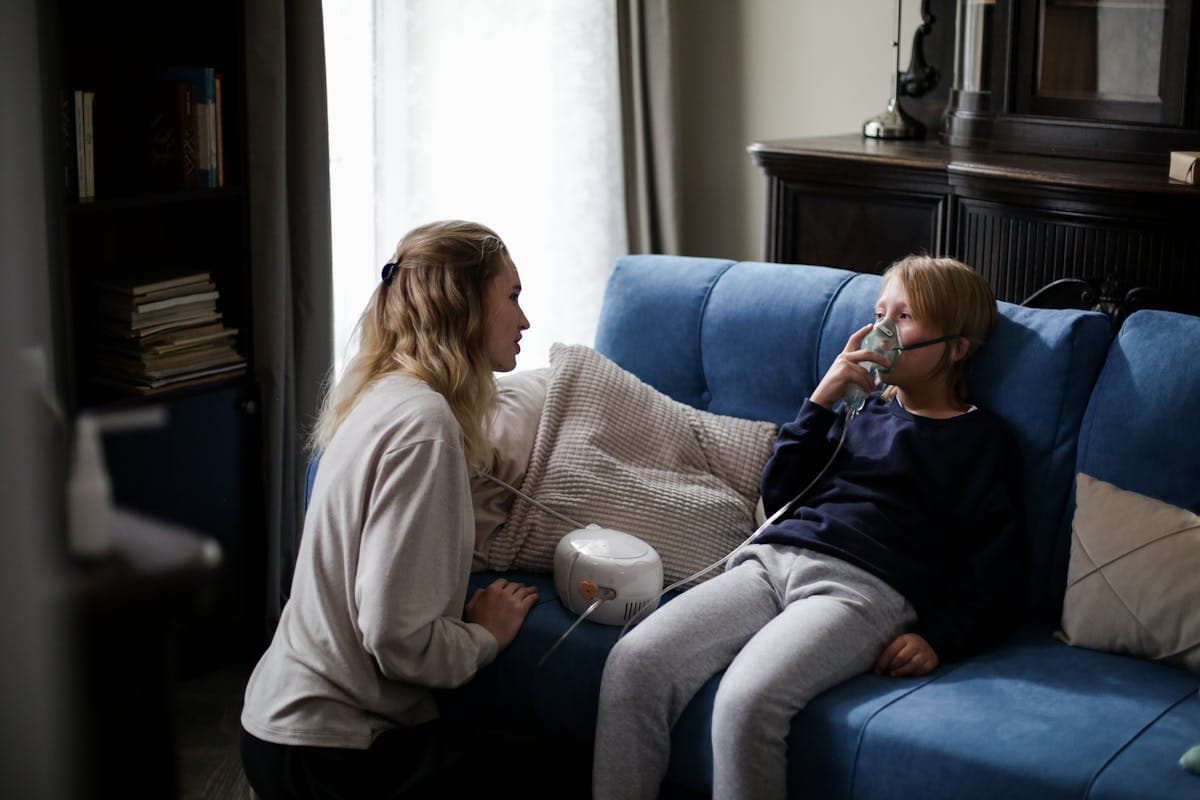
Home Inhalation and Nebulisation: When to Do It and How
A cough, runny nose, and hoarse voice are the classic autumn-winter package that visits households with depressing regularity. In pharmacies and parenting forums the same question keeps coming up: should you do inhalations or not? And if so — with what, for how long, and can a child do this every day? The answers are less straightforward than they might seem.
Inhalations can be an effective aid for upper respiratory tract infections — but only when you use the right substances, the right equipment, and follow basic hygiene rules. Done incorrectly, they can do more harm than good: irritating the mucous membrane, pushing bacteria deeper into the airways, or — in the case of young children — causing a dangerous burn.
This article gives you specific guidance: when to reach for a nebuliser versus when a bowl of steam is enough, what you should absolutely never put in a child's nebuliser, and how to keep your equipment clean so it does not become a breeding ground for bacteria.
Steam Inhalation — A Simple Method with Limited Reach
Steam inhalation is the oldest home remedy for clearing the airways. It involves breathing warm, humidified steam — from a bowl of hot water, a dedicated steam inhaler, or simply a container covered with a towel.
What does steam actually do?
Steam humidifies and warms the mucous membrane of the nose and throat, making it easier to clear secretions. It can bring temporary relief for a dry cough, hoarseness, and a stuffy feeling. That is the full extent of it — steam works exclusively in the upper airways (nose, throat, larynx) and does not reach the bronchi or lungs.
When does steam inhalation make sense?
- For dryness and irritation of the nasal and throat mucous membrane
- As a supplement to cold treatment in adults and older children (above 6–7 years)
- As support for hoarseness and dry cough
What NOT to do with steam inhalation?
- Do not use in infants and young children under 3 years old — the risk of scalding from hot water or steam is very high; children this age cannot control their head movements
- Do not add essential oils for children under 6–7 years — eucalyptol, menthol, and camphor can trigger laryngospasm and airway irritation, and in extreme cases breathing difficulties
- Do not lean the face too close to the hot water — keep at least 30 cm away
- Do not drape a child under a towel together with the bowl — you lose control over the steam temperature
Nebulisers — When One Is Really Worth Having
A nebuliser (pneumatic or ultrasonic inhaler) turns liquid into a fine aerosol that penetrates far deeper than steam — reaching the trachea, bronchi, and with an appropriately small particle size even the bronchioles. This is precisely what gives it an advantage over traditional steam inhalation.
Types of nebulisers
- Pneumatic (piston/compressor) — the most common home type, generating aerosol with compressed air. Durable, inexpensive to run, effective. The one drawback: it is fairly noisy.
- Ultrasonic (mesh) — quiet, compact, cordless. Better tolerated by children. Higher upfront cost, but the medication retains its properties well (lower aerosol temperature).
- Vibrating mesh — the newest generation, finest aerosol, highest effectiveness at delivering medication to the lower airways.
When home nebulisation is indicated
- Recurrent upper and lower respiratory tract infections in children
- Bronchial asthma (following a doctor's recommendation and with prescribed medication)
- Bronchitis with thick secretions that are hard to cough up
- Chronic sinusitis
- Laryngitis and croup (after medical consultation)
It is worth knowing that a nebuliser is not a remedy for every cough. With a dry viral cough and no secretions (for example in the first 24 hours of a cold), plain saline will provide very little relief — humidifying the room and staying well hydrated may be more helpful. Nebulisation makes the most sense when thick, pooling secretions make breathing or coughing difficult.
What Can Go in a Nebuliser — Safe Liquids
This is one of the most important sections of this article. Many people pour whatever they have to hand into a nebuliser — and make dangerous mistakes in doing so.
Physiological saline (0.9% NaCl)
This is the standard, most widely used nebuliser liquid. Isotonic sodium chloride 0.9% moisturises the mucous membrane, thins secretions, and helps clear them. It is safe for infants, children, and adults. Available at pharmacies as ready-to-use ampoules of 2 or 5 ml (single-use — this matters for sterility).
Physiological saline does not treat infections, but it supports the natural airway-clearance mechanisms. It can be used several times a day without any risk of dependency or side effects.
Hypertonic saline (3% NaCl)
A higher-concentration salt solution — 3% NaCl — has stronger cleansing properties. It works osmotically, "drawing out" water from the mucosa and thinning thick secretions. It is particularly recommended for chronic sinusitis, cystic fibrosis, and bronchitis with sticky, hard-to-clear phlegm.
Note: hypertonic saline can irritate the airways and trigger a cough reflex or bronchospasm. In children under 2 years old it should only be used after consulting a paediatrician. Available at pharmacies as ready-to-use 3% or 6% ampoules.
How much does your basket cost?
See how much your basket costs across pharmacies — free, no registration
Compare pricesThermal and mineral water — with caution
Some thermal waters are available in formulations for nebulisation. These can be used, but only water specifically intended for inhalation — never ordinary mineral water from a shop, which is not sterile and may contain impurities and minerals at concentrations unsuitable for the airways.
Prescription medications
Inhaled medications — ipratropium bromide, salbutamol, budesonide, acetylcysteine — can be added to a nebuliser, but only on a doctor's prescription. Self-administering inhaled medications (even those available without a prescription in some countries) in children is not acceptable without a diagnosis.
What You Should NEVER Put in a Nebuliser
This list is short, but every item on it can be dangerous — particularly for children:
- Essential oils (eucalyptus, menthol, thyme, rosemary) — not intended for nebulisation; they irritate the bronchial mucosa, can trigger an airway spasm; in children under 6 they risk serious breathing difficulties
- Teas and herbal infusions — not sterile, contain plant particles, can damage the nebuliser and contaminate the airways
- Aromatherapy preparations — even if the packaging says "natural," that does not mean they are suitable for nebulisation
- Tap water or ordinary shop mineral water — incorrect osmolality, risk of infection
- Syrups and oral medications — oral formulations are not designed for inhalation; they can damage the equipment and the airways
Nebuliser Hygiene — The Step Most People Skip
A nebuliser is an ideal environment for bacteria and fungi — warmth, moisture, remnants of secretions. Neglected equipment can cause new infections instead of treating them.
After every use
- Disassemble all parts that come into contact with liquid and aerosol (medication cup, mask or mouthpiece, tubing)
- Rinse with warm water and washing-up liquid or mild soap
- Rinse thoroughly with clean water
- Dry on a clean towel or leave to air-dry — never put damp parts back in their container
Once a week (or after any infection)
- Disinfect plastic parts: soak in a vinegar solution (1:3 with water) or a dedicated disinfectant for 30 minutes
- Rinse with sterile or boiled water
- Dry completely before reassembling
Many pharmacies stock ready-made nebuliser cleaning kits — disinfectant tablets or citric-acid-based solutions. These are convenient and safe for plastic components. Avoid alcohol- or chlorine-based products — they can degrade gaskets and silicone parts, shortening the equipment's lifespan.
Replacement and component lifespan
- Mask and mouthpiece: replace every 6–12 months, or when discolouration or odour appears
- Tubing: replace every 12 months
- Air filter (in compressor models): every 3–6 months or as the manufacturer specifies
- Medication cup (mesh nebuliser): every 6–12 months
Never use a nebuliser with damaged tubing, cracks in the medication cup, or a leaking mask — the aerosol may not reach the airways, and the equipment itself may be contaminated.
Storing your nebuliser
Store a clean, dry nebuliser in a clean, dry place — ideally in the bag or dedicated case included by the manufacturer. Avoid bathroom cabinets with high humidity. If the equipment has been sitting unused for several weeks, carry out a full disinfection of all parts that come into contact with aerosol before the next use, even if they look clean — microorganisms on dry surfaces can survive for up to two weeks.
How to Do an Inhalation Correctly — Technique Matters
Even the best nebuliser and the right liquid will achieve little if the inhalation is carried out incorrectly.
- Position: sitting or semi-reclined (never lying flat) — this helps the aerosol reach the lower airways
- Mask vs mouthpiece: use a face mask for children under 4–5 years old; older children and adults should use a mouthpiece — the efficiency is higher because less aerosol disperses into the air
- Breathing: calm, deep breaths through the mouth; every few breaths you can hold the air for 2–3 seconds to allow the aerosol to settle
- Duration: typically 10–15 minutes or until the liquid in the cup is exhausted
- Frequency: for saline — 2–4 times a day; for medications — as directed by a doctor
- After inhalation: clear the nose, rinse the mouth (especially after inhaled corticosteroids), and encourage coughing up secretions
When Inhalation Is Not Enough — Warning Signs
Inhalations are a support measure, not a causal treatment. There are situations that require immediate medical attention:
- Breathlessness, rapid breathing, or wheezing — especially in children; may indicate bronchitis, asthma, or croup
- A fever above 38.5 °C (101 °F) lasting more than 3 days in children, or above 39 °C (102 °F) in adults
- Chest pain when breathing
- Cyanosis — bluish discolouration of the lips or fingernails
- An infant under 3 months old with any sign of a respiratory infection
- No improvement after 5–7 days of home treatment, or deterioration after initial improvement
- Intensifying cough with yellow or green sputum accompanied by fever
Steam inhalation with physiological saline cannot replace antibiotics for bacterial sinusitis, middle ear infection, or pneumonia. If anything worries you — see a doctor.
Frequently Asked Questions
Can I do inhalations as a preventive measure, without an infection?
Yes — in people with dry airways, asthma, or chronic respiratory conditions, nebulisation with physiological saline can be used preventively, but always after consulting a doctor or pharmacist. In healthy children without chronic problems there is no medical indication for routine "precautionary" inhalations.
Is an ultrasonic nebuliser better for children?
It is quieter, which makes it considerably easier to carry out inhalations in small, restless children. In terms of effectiveness, modern vibrating-mesh nebulisers perform best. More important than the type of device, however, is regular cleaning and correct technique — even an inexpensive compressor nebuliser used properly is effective.
My child cries during nebulisation — what should I do?
Breathing while crying is fast and shallow — the aerosol does not reach deep. Try offering a cartoon, a game, or a toy during the session. If the child is very young and does not tolerate the mask, you can try nebulising during sleep (hold the mask close to the face without pressing it). A nebuliser shaped like an animal or toy can also help.
Are eucalyptus oils really that dangerous for children?
Yes. The active components of eucalyptus oil — eucalyptol (1,8-cineole) — along with camphor and menthol can cause laryngospasm and respiratory depression in children under 6. Cases of poisoning are documented in the medical literature even with small doses. These substances must not be used in a nebuliser for young children — this is an absolute contraindication, not a question of dosage.
Do inhalations help with sinusitis?
Nebulisation with hypertonic saline (3% NaCl) can relieve sinusitis symptoms — it moisturises and thins pooling secretions. However, bacterial sinusitis with fever and severe pain requires medical evaluation and often antibiotic treatment. Inhalation alone cannot cure a bacterial infection.
How long can an opened saline ampoule be stored?
Ready-to-use saline ampoules for nebulisation are single-use — once opened, use the contents immediately or within a maximum of 12 hours (if stored in a sealed container in the fridge). Keeping an opened ampoule longer exposes it to bacterial contamination. Sterility is not worth compromising on.
Summary
✅ 0.9% physiological saline is a safe, standard nebulisation liquid — suitable for children of all ages.
✅ 3% hypertonic saline thins secretions more effectively, but requires a doctor's consultation in young children.
✅ Essential oils (eucalyptus, menthol, camphor) are absolutely contraindicated in a nebuliser for children under 6 years old.
✅ Clean your nebuliser after every use and disinfect it once a week — neglected equipment can spread infections.
✅ Steam inhalation works only in the upper airways; a nebuliser reaches deeper — all the way to the bronchi.
✅ Inhaled medications (salbutamol, budesonide) should only be used in a nebuliser on a doctor's prescription and under medical supervision.
✅ Breathlessness, wheezing, and a fever lasting more than 3 days are signals that medical help is needed — not another inhalation.
Disclaimer
This article is purely educational and does not replace a medical consultation or pharmaceutical advice. If you have any doubts about the use of inhalations — particularly for infants, young children, or people with chronic conditions — consult a doctor or pharmacist.
If inhalations are a regular part of your home health routine, keep in mind that physiological saline, hypertonic saline, and nebuliser accessories are products you buy repeatedly — and their prices can vary considerably from one pharmacy to another. On CheaperForDrug you can add all the products you need to a single basket and compare the total cost across various online pharmacies, because real savings come from comparing your whole basket, not just a single pack.